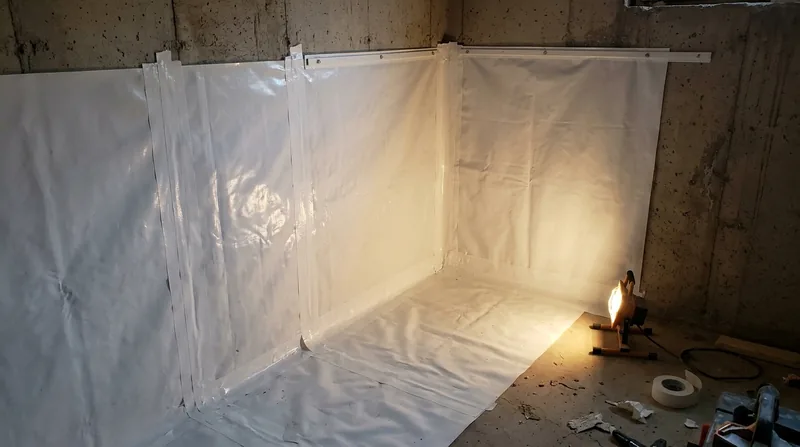




If you own an older home in the Old West Side or a 1960s ranch out in Pittsfield, you already know the ground here holds water. Ann Arbor sits on glacial clay loam over sand and gravel, and the Huron River valley keeps the water table high from late winter into spring. That clay drains slowly, so snowmelt and fast summer thunderstorm runoff push moisture vapor straight through fieldstone, early poured concrete, and block walls. Vapor Barrier Installation in Ann Arbor is the below-grade answer to that constant vapor drive: heavy-duty sheets sealed across walls and slab to block ground moisture before it ever reaches your living space. We install it as a dedicated waterproofing specialist, not as a general foundation firm or a plumber. Start with a free basement inspection so we can read your walls and slab before quoting anything.
Why Vapor Barriers Matter in Ann Arbor's Glacial Clay and River Valley Basements
Ann Arbor basements were not built to stay dry on their own. The 1900s to 1920s brick and frame bungalows and foursquares in the Old West Side often have full basements with fieldstone or early poured walls that weep vapor year round. Burns Park and Kerrytown colonials and Cape Cods from the 1930s to 1950s sit on block walls with hairline cracks that the long freeze-thaw cycle opens wider each winter. In Westgate, Pittsfield, and Geddes Heights, the 1950s through 1990s ranches and split-levels have poured full basements where slab moisture wicks up into stored boxes and framing.
- Clay soil traps water against the footing, so hydrostatic pressure pushes vapor through the wall rather than letting it drain away.
- The high spring water table in the Huron River valley keeps the lower block saturated well into April and May.
- Freeze-thaw cycles open hairline cracks that let liquid water and vapor both through the wall assembly.
- Efflorescence and a musty basement smell are the visible signs that moisture vapor is moving through the concrete right now.
A vapor barrier stops that vapor at the surface, which is why we treat it as a core part of below-grade moisture control and not a cosmetic add-on.
Key info: A 1920s foursquare near Eberwhite Woods with a fieldstone wall will wick far more vapor than a 1970s Pittsfield ranch with poured walls. We size the barrier and the seam sealing to the wall type, not to a one-size template.
For official guidance on basement moisture and building performance, the U.S. Department of Energy's Building America program publishes solid reference material at energy.gov/eere/buildings/building-america. It is worth a read before you approve any below-grade work.
How We Install Vapor Barriers in Ann Arbor Basements, Step by Step
We do not staple plastic to a wall and call it done. Every install starts with a moisture read of the wall and slab, because a barrier over an actively leaking crack just traps water behind it. If we find hydrostatic pressure feeding a wall, we say so and explain why an interior drain tile system is the better first move. When the wall is sound, the vapor barrier goes on as a sealed system: sheets, seams, terminations, and sump integration all working together.
- We inspect the basement walls and slab, map efflorescence and damp zones, and check the sump basin and discharge line.
- We repair active cracks first, using epoxy or polyurethane injection depending on whether the crack is structural or seeping.
- We clean and parge rough fieldstone or spalling block so the barrier has a continuous surface to bond to.
- We hang heavy-duty vapor barrier sheets across the walls with a dimple board standoff where drainage is needed.
- We seal every seam and tape every termination, then tie the slab sheet into the sump basin so vapor cannot bypass the system.
- We test the sump pump and check valve, then walk you through what the barrier does and does not cover.
Each step is documented, and you get a plain explanation of the finished assembly before we leave.
Key info: On a 1950s Cape Cod in Burns Park, we found the slab wicking moisture into a finished corner. We sealed two hairline cracks, installed the wall and slab barrier, and tied the slab sheet into the existing sump basin. The musty smell cleared within two weeks once the vapor drive stopped.
If your barrier ties into a sump system, see how we handle sump pump installation and replacement so the discharge line and check valve match the barrier layout.
Vapor Barrier Approaches We Use in Ann Arbor Homes
Not every basement needs the same assembly. We match the approach to the wall material, the moisture reading, and whether the space is finished or raw. The table below shows the four configurations we install most often in Ann Arbor and the surrounding townships.
| Approach | Description | Best for |
|---|---|---|
| Wall sheet with dimple board | Heavy-duty barrier on a drainage standoff, sealed seams and taped terminations | Block and poured walls with mild seepage |
| Slab barrier with sump tie-in | Sheet laid over the slab, lapped into the sump basin and sealed at the perimeter | Finished basements with slab wicking |
| Full wall and slab envelope | Continuous barrier from footing to rim, with sealed transitions at corners | Old West Side fieldstone and damp full basements |
| Parge and membrane coat | Surface prep and waterproof membrane under the barrier on rough walls | Spalling block and uneven masonry |
We confirm the right approach on site, because a photo cannot tell us how much vapor the wall is actually passing.
Vapor Barrier Installation Cost in Ann Arbor: What to Expect
Most Ann Arbor vapor barrier work starts from $3 per square foot, and that figure covers the barrier, dimple board where needed, seam sealing, and sump tie-in. The final number moves with wall height, how much surface prep the fieldstone or block needs, whether active cracks require injection first, and how much of the slab is covered. A raw 1960s Pittsfield ranch basement is a simpler job than a finished Old West Side basement where we have to work around framing and stored contents.
We quote after the inspection, not over the phone, because the wall type and moisture reading drive the scope. Getting two or three estimates is smart, and we encourage you to compare what each one includes: seam sealing, parging, crack repair, and sump integration are the line items that separate a real vapor barrier from a sheet of plastic. Our full pricing overview breaks down the components so you can compare apples to apples.
Hiring a Vapor Barrier Contractor Near Ann Arbor: What to Check
Vapor barrier work is below grade and mostly hidden once it is done, so the contractor you pick matters more than the sheet itself. Ask for proof of licensing and insurance before anyone steps into your basement, and get the certificate sent to you directly. Compare at least two or three written estimates that list materials and seam sealing separately, and ask for references from jobs in Ann Arbor or the nearby townships. If your home is in a historic district or an HOA, confirm whether the work touches any protected exterior element before scheduling.
Permits are commonly required for structural foundation repair and for work that alters drainage or the sanitary connection of a sump discharge, and thresholds vary by jurisdiction. Always verify with the City of Ann Arbor building department before work begins. Reach out through our contact page to schedule your free inspection.
Vapor Barrier Installation in Ann Arbor: Pricing Guide
| Service | Price | Details |
|---|---|---|
| Wall vapor barrier with dimple board | Starting at $3/sq ft | Includes heavy-duty sheet, dimple board standoff, sealed seams, and taped terminations on block or poured walls |
| Slab barrier with sump tie-in | Starting at $3.50/sq ft | Includes slab sheet, perimeter seal, and lapped connection into the sump basin and check valve |
| Full wall and slab envelope | Starting at $4/sq ft | Continuous footing-to-rim barrier with sealed corner transitions, priced higher for fieldstone and finished spaces |
| Surface prep and parging | On estimate | Rough fieldstone and spalling block need prep and membrane coat before the barrier goes on |
| Travel | Included | In Ann Arbor and surrounding areas, no separate call-out or mileage fee |
| Estimate | Free | Response within 24h at (734) 519-7691, no obligation to book |
Indicative pricing, the exact cost depends on square footage, finish, and site access. Free personalized estimate within 24h at (734) 519-7691.


