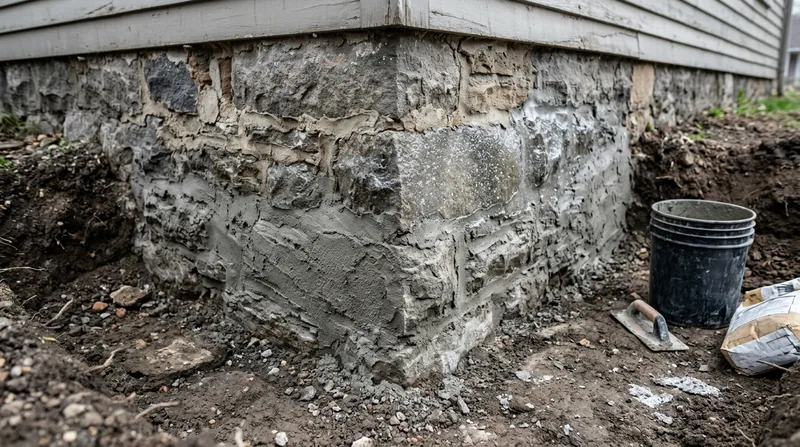




Foundation Waterproofing in Ann Arbor starts with reading the ground, not the wall. This city sits on glacial clay loam over sand and gravel, and the Huron River valley keeps the water table high from late winter into spring. Old West Side bungalows and foursquares from the 1900s to 1920s often sit on fieldstone or early poured walls that have been wicking moisture for a century. Burns Park and Kerrytown colonials and Cape Cods from the 1930s to 1950s have full basements that take on water when snowmelt and slow-draining clay push runoff toward the footing drain. We match the repair to the foundation type: parging and crack injection on fieldstone and block, membrane or crystalline treatments on early poured concrete, and drainage correction where hydrostatic pressure is the real driver. If you are seeing efflorescence, wall seepage, or water after rain, start with a free basement inspection before anyone quotes a fix.
Why Foundation Waterproofing Matters in Ann Arbor's Clay and Freeze-Thaw Cycle
Ann Arbor's residential stock is old enough that many foundation walls have already survived decades of freeze-thaw winters that open hairline cracks a little wider each year. The dominant failure mode here is not a single catastrophic breach. It is slow, seasonal water movement: snowmelt in March, clay that drains slowly, and fast summer thunderstorm runoff pushing water toward footing drains and low corners. When the water table rises, hydrostatic pressure finds every unsealed joint, tie rod hole, and cold pour seam in a poured wall.
- Fieldstone and early poured walls in the Old West Side and Downtown need period-appropriate parging and crack repair, not a modern dimple board slapped over failing mortar.
- Block walls in 1950s and 1960s Westgate ranches wick water through the cores and show efflorescence at the base, which means moisture is moving through the masonry, not just sitting on it.
- Poured full basements in Pittsfield and Geddes Heights subdivisions develop shrinkage cracks at tie holes and along cold joints that open under hydrostatic pressure.
- Walkout basements on sloped lots collect water at the low wall and window wells when grading and downspout extensions are not moving roof water away from the foundation.
The right answer depends on whether you have a crack problem, a drainage problem, or both, and the inspection tells us which before we touch a wall.
Key info: A 1920s foursquare off West Liberty with a fieldstone wall and white efflorescence is usually a parging and drainage correction job. A 1965 Westgate ranch with water at the cove joint after every March thaw is usually a hydrostatic pressure problem that needs an interior perimeter drain, not another coat of sealer. We tell you which one you have.
Permits for structural foundation repair and work that alters drainage vary by jurisdiction, so we always confirm with the City of Ann Arbor building department before scheduling. You can verify local permit requirements through the City of Ann Arbor planning and development permit office.
How We Waterproof a Foundation in Ann Arbor, Step by Step
We start by walking the basement and the exterior grade together, because the story is never only on one side of the wall. We look at the wall type, the crack pattern, the cove joint, the footing drain, the sump basin, and where the lot drains. Then we map the water path and recommend the least invasive repair that actually solves it. On a fieldstone wall, that may mean repointing and parging before any coating. On a poured wall with active seepage, it may mean polyurethane injection at the crack and a drainage fix at the base.
- Inspect and map the wall, floor joint, drain tile, sump basin, and exterior grading to identify whether the source is a crack, a drain failure, or hydrostatic pressure.
- Test the drainage by checking the sump pump, check valve, and discharge line, and by confirming the footing drain is actually moving water.
- Repair the wall with epoxy or polyurethane injection at structural cracks, parging on fieldstone, and crystalline or membrane treatment on early poured concrete as the wall type allows.
- Correct the drainage with an interior perimeter drain and sump basin where pressure is the driver, or exterior membrane and dimple board where the wall itself needs protection from wet soil.
- Verify and hand off with a wet test, a clear explanation of what was done, and a transferable warranty on the work.
Every job ends with the same question: will this wall stay dry through the next March thaw and the next July downpour, not just this week.
Key info: A 1950s Cape Cod in Burns Park had water crossing the floor every spring and a sump pump that ran constantly. The footing drain was clay-tile and collapsed. We installed an interior perimeter drain feeding a new sump basin with a check valve, replaced the discharge line, and extended the downspouts. The pump now cycles seasonally instead of continuously. That is a drainage correction, not a wall coating.
If the inspection shows the wall itself is the weak point, we move to exterior basement waterproofing with membrane and dimple board. If the problem is interior pressure, the better answer is often an interior drain tile system.
Foundation Waterproofing Methods We Use in Ann Arbor
Not every wet wall needs the same treatment, and the method has to match the wall material and the water source. Here is how we decide between the main approaches on Ann Arbor foundations.
| Approach | Description | Best for |
|---|---|---|
| Crack injection (epoxy or polyurethane) | Ports are set along the crack and resin is injected to fill the full depth of the wall. | Non-moving shrinkage and tie-hole cracks in poured walls. |
| Parging and masonry repair | Failing mortar is cut out and repointed, then the wall is parged with a compatible mix. | Fieldstone and early block walls in Old West Side and Downtown homes. |
| Exterior membrane and dimple board | The wall is excavated, waterproofed, and protected with drainage board and washed stone. | Walls with failed exterior coating and accessible grade. |
| Crystalline waterproofing | A cementitious treatment that grows crystals into the pores of the concrete to block water. | Early poured concrete walls that need a breathable treatment. |
| Interior perimeter drain and sump | A drain is cut into the floor perimeter and tied to a sump basin and pump. | Hydrostatic pressure and high water table, as in the Huron River valley. |
The method table is a starting point, not a prescription. The inspection decides.
Foundation Waterproofing Cost in Ann Arbor: What to Expect
Most Ann Arbor foundation waterproofing work starts at From $3,500 for a focused repair such as crack injection with drainage correction on a single wall. Full perimeter drainage or exterior excavation on a larger basement runs higher. The factors that move the number are the wall type (fieldstone costs more to prep than poured), the linear footage involved, whether a sump basin and pump are part of the scope, access for excavation equipment, and whether the job is a routine spring repair or an emergency after a storm.
We give you a written scope before any work starts, and we tell you when a simple crack seal is enough and when the real problem is pressure that needs drainage. Getting two or three estimates is smart on any foundation job, and it is the fastest way to spot a quote that is selling excavation you do not need. Our full pricing overview breaks down the ranges by method.
Key info: A 1960s split-level in Pittsfield with water at the cove joint and a working sump pump is often an interior drain job, which is a different price than exterior excavation. A 1930s colonial in Kerrytown with a single active crack and dry walls elsewhere is often an injection job at the lower end. We quote the scope you actually need.
What to Look for When Hiring a Waterproofing Contractor Near Ann Arbor
Foundation work is not the place to hire the first truck that shows up after a storm. Ask for proof of licensing and insurance, and ask whether the crew is employees or subcontractors. Get two or three written estimates with a clear scope, and check references from jobs in Ann Arbor or nearby Ypsilanti, Saline, or Dexter that match your foundation type. Confirm who pulls the permit for any structural repair or drainage alteration, and ask how the company handles any HOA requirements on exterior work.
Before you sign anything, call us at (734) 519-7691 or request a free inspection so you can compare our scope against the other quotes on the table.
Foundation Waterproofing in Ann Arbor: Pricing Guide
| Service | Price | Details |
|---|---|---|
| Crack injection and wall sealing | Starting at $3,500 | Includes injection ports, epoxy or polyurethane resin, and surface sealing on accessible cracks. |
| Interior perimeter drain and sump | Starting at $6,500 | Includes drain tile, sump basin, pump, and check valve; linear footage drives the price. |
| Exterior membrane and dimple board | Starting at $9,500 | Includes excavation, waterproof membrane, drainage board, and washed stone backfill on accessible walls. |
| Complex or large-scale job | On estimate | Fieldstone walls, walkouts, and multi-wall scopes need an on-site look before pricing. |
| Travel | Included | In Ann Arbor and surrounding areas, no separate call-out or mileage fee. |
| Estimate | Free | Response within 24h at (734) 519-7691, no obligation to book. |
Indicative pricing, the exact cost depends on square footage, finish, and site access. Free personalized estimate within 24h at (734) 519-7691.


