



Bowing Wall Repair in Ann Arbor: When Wet Clay Pushes Back
If you own a home in Ann Arbor, you already know the ground here holds water. The glacial clay loam over sand and gravel, combined with a water table that stays high from late winter into spring, puts steady pressure on basement walls across the Old West Side, Burns Park, and Kerrytown. Many of those 1900s to 1920s brick and frame bungalows and foursquares still sit on fieldstone or early poured concrete walls, and wet clay pressing in from the outside is the reason a wall starts to lean.
Our Bowing Wall Repair in Ann Arbor work stops that movement and stabilizes the wall before it gets worse. We assess the severity of the bow, the soil load, and the wall material, then match the repair to the actual condition instead of selling the same fix to every house. If you have noticed a horizontal crack, a wall that bulges inward, or doors that no longer close square, call (734) 519-7691 for a free inspection. You can also review our foundation crack repair page to understand how wall cracks and wall movement differ.
Why Bowing Walls Are Common in Ann Arbor's Older Neighborhoods
Ann Arbor sits in the Huron River valley, and the freeze-thaw winters here open hairline cracks while spring snowmelt and slow-draining clay push water toward footing drains and low corners. On a block or early poured wall, that hydrostatic pressure has nowhere to go but inward. A wall that was plumb in 1950 can lean two inches by the time the basement smells musty and efflorescence shows up along the bottom course.
The building stock tells the story. Old West Side fieldstone walls were never built for modern water loads. Burns Park and Kerrytown colonials and Cape Cods have full basements with block walls that have taken decades of clay pressure. Westgate and Pittsfield ranches and split-levels often show the problem on the uphill side, where the grade feeds water straight toward the wall.
- A horizontal crack in the middle third of a block wall usually signals active pressure, not just settling.
- Doors and windows that stick on one side of the basement often mean the wall has rotated inward.
- Efflorescence, the white powder on the wall, tells you water is moving through the concrete or block.
- Stair-step cracking along mortar joints on a block wall points to differential movement that should be checked.
None of these should wait a season. Movement that is slow today can accelerate through the next wet spring.
Key info: On a 1920s foursquare near the Old West Side, we measured a 2.5 inch bow on a block wall after a wet March. Carbon fiber straps stabilized it without excavation. A fieldstone wall on the same street needed a different approach because the mortar, not the block, was failing.
Structural foundation repair in Michigan is generally permitted work, and the rules vary by jurisdiction, so confirm requirements with the City of Ann Arbor planning and development department before work begins. We help you sort out what applies to your address.
How We Diagnose and Stabilize a Bowing Wall in Ann Arbor
We start by reading the wall, not by quoting a product. The inspection covers the bow measurement, the wall material, the soil load, and how the water is reaching the foundation. A wall that is bowing because of clay pressure and a wall that is bowing because the footing drain is clogged need different repairs, and we say so plainly.
- We measure the deflection at the worst point and map the crack pattern across the wall.
- We check the exterior grade, the downspout extensions, and the footing drain to see where water is loading the wall.
- We identify the wall type, fieldstone, block, or poured concrete, because the repair method depends on it.
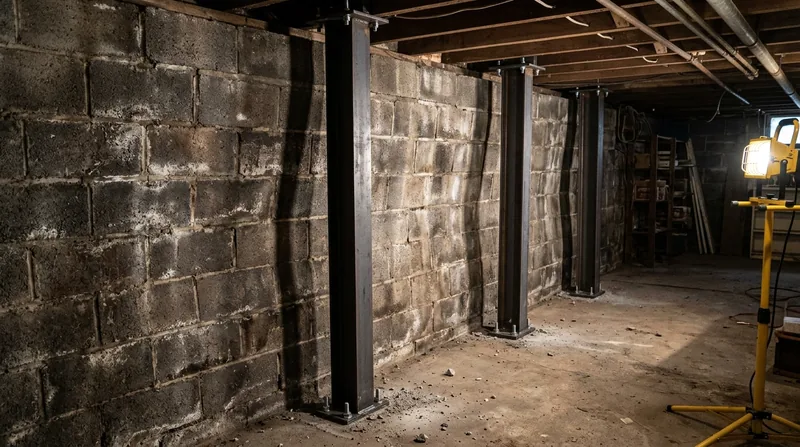
- We recommend carbon fiber straps, steel I-beams, or wall anchors based on the severity of the movement.
- We install the system, torque it to spec, and document the starting measurement so future movement can be compared.
- We address the water source with drainage or sealing so the pressure does not simply return.
Stabilization without water control is a short-term fix, and we treat it that way.
Key info: A split-level in Pittsfield showed a 1.5 inch lean on the uphill wall. The footing drain was clogged with clay and silt, so water was sitting against the wall all spring. We installed wall anchors and cleared the drainage path. The wall has held its measurement through two wet seasons.
If the inspection shows the wall is sound and the real issue is water coming through cracks, our basement wall sealing service is often the honest answer. Not every wet wall is a structural wall. For homes in the 48104 ZIP code, you can also see the 48104 bowing wall repair page for neighborhood-specific notes.
Repair Methods We Use and When Each One Fits
There is no single repair for a bowing wall. The right method depends on how far the wall has moved, what the wall is made of, and how much clay pressure it is carrying. Here is how we match the approach to the condition.
| Approach | Description | Best for |
|---|---|---|
| Carbon fiber straps | Straps bonded vertically to the wall and anchored at floor and ceiling to resist inward movement. | Block walls with moderate bowing and no active rotation at the top. |
| Steel I-beams | Vertical steel beams set against the wall and tied into the floor and joists to brace the wall. | Poured and block walls with heavier movement or a wall that is still moving. |
| Wall anchors | Anchors driven into exterior soil and connected to interior plates to pull the wall back and hold it. | Walls that need to be straightened, where exterior access allows. |
| Epoxy or polyurethane injection | Cracks filled under pressure to close the water path after the wall is stabilized. | Cracks in a wall that is otherwise structurally sound. |
| Drainage correction | Footing drain repair, grading, and downspout extensions to reduce the water load on the wall. | Any bowing wall where water pressure is the driving cause. |
We combine these methods when the wall needs both stabilization and water control, which is common on the older full basements here.
Bowing Wall Repair Cost in Ann Arbor: What to Expect
Homeowners ask for a number before they ask for anything else, and that is fair. Bowing wall repair is not a one-price job, though. A single wall with a 1 inch bow and a dry basement is a different scope from a fieldstone wall that has been taking clay pressure for thirty years. Our pricing starts at $600 for the smallest crack and stabilization work, and a full wall anchor or I-beam installation on a bowing wall runs well above that.
The factors that move the number are the wall length and height, the wall material, the repair method, how much excavation the anchors require, and whether drainage work is part of the job. A wall that also needs footing drain work or a sump upgrade will carry that cost too. We put the full breakdown on our pricing page so you can see how the pieces add up before anyone visits.
Get two or three estimates and compare the diagnosis, not just the total. A quote that skips the water source is likely to leave you with a wall that keeps moving.
Hiring a Bowing Wall Repair Contractor Near Ann Arbor
You want a contractor who reads the wall before quoting a product. Ask whether the company is licensed and insured, request the certificate, and check references from jobs in Ann Arbor or a neighboring city with similar soil and wall types. Ask how they will measure the bow, what method they recommend and why, and whether the water source will be addressed.
Permits matter here. Structural foundation repair commonly requires a permit, and the threshold varies by jurisdiction, so confirm the requirement with the local building department. If your home is in a historic district or under an HOA, check those rules before work starts. A contractor who is comfortable talking through permits is a good sign.
We keep the process simple. You can contact us to schedule a free inspection, and we will tell you plainly whether the wall needs stabilization or just crack sealing and drainage work.
Bowing Wall Repair in Ann Arbor: Pricing Guide
| Service | Price | Details |
|---|---|---|
| Crack injection and minor stabilization | Starting at $600 | Covers epoxy or polyurethane injection on sound walls plus basic crack prep, with wall length the main cost driver. |
| Carbon fiber strap installation | Starting at $1,800 | Includes strap layout, bonding, and anchoring; number of straps and wall height move the price. |
| Steel I-beam bracing | Starting at $3,200 | Covers beam placement and floor and joist tie-in; wall length and access determine the final figure. |
| Wall anchor system | On estimate | Requires exterior excavation and soil assessment, so an on-site look is needed before quoting. |
| Drainage correction add-on | On estimate | Footing drain repair, grading, or downspout work priced after the water path is inspected. |
| Estimate | Free | Response within 24 hours at (734) 519-7691, no obligation to book. |
Indicative pricing, the exact cost depends on square footage, finish, and site access. Free personalized estimate within 24h at (734) 519-7691.


