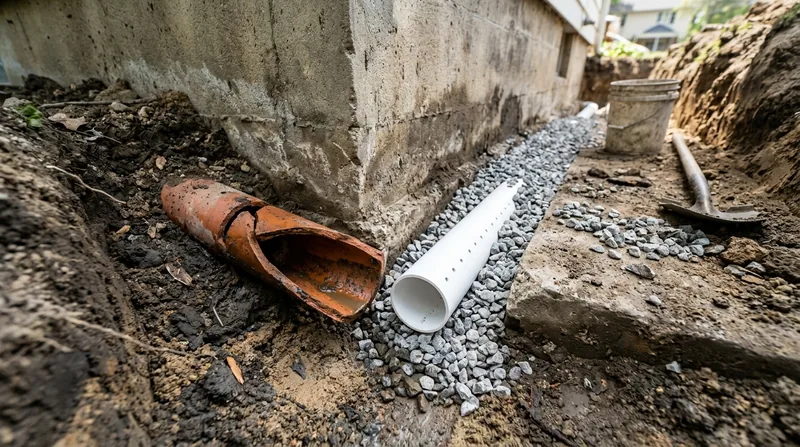




If your basement takes on water every spring, or you see a wet corner after a heavy July thunderstorm, the footing drain around your foundation may have stopped doing its job decades ago. Drain Tile Repair & Replacement in Ann Arbor means finding the failed run of tile, confirming it with a camera, and replacing it with modern PVC that actually carries water to the sump basin. Many homes in the Old West Side and Burns Park still sit on original clay tile laid when the Huron River valley water table was a problem nobody talked about. Glacial clay loam holds that water against your footing until the old tile silts shut or tree roots crush it flat. We open the trench, replace the failed section, and restore drainage so the water goes where it belongs. If you want the bigger picture first, start with our basement waterproofing service and we will tell you honestly whether you need tile work or just a crack sealed.
Why Failed Drain Tile Is the Real Story Behind Wet Basements in Ann Arbor
Ann Arbor sits on glacial clay loam over sand and gravel, and the Huron River valley keeps the water table high from late winter into spring. That clay drains slowly, so snowmelt and summer thunderstorm runoff pool against the footing instead of soaking away. When the original clay tile is clogged, root-bound, or collapsed, the water has nowhere to go but through the wall. That is when you see efflorescence, a musty basement smell, or water after rain. The fix is not always a new interior system; sometimes it is restoring the drain that was already there.
- Original clay tile in 1900s-1920s Old West Side bungalows has often collapsed or filled with silt over the last century.
- Tree roots from mature maples and oaks find the joints in old tile and grow through the pipe until it is fully blocked.
- Long freeze-thaw winters open hairline cracks in early poured concrete and block walls, and a dead footing drain lets that water in.
- 1950s-1960s ranches in Westgate and split-levels in Pittsfield often have poured full basements whose tile was undersized by modern standards.
In every one of these cases, the symptom (water in the basement) is the same, but the repair is different, which is why a camera inspection comes before any shovel hits the ground.
Key info: A homeowner in the Burns Park area called us after three springs of water on the basement floor. The wall was sound and the crack was minor. The original clay tile under the front footing had collapsed under a maple root. We replaced 28 feet of tile with PVC and the water stopped. No interior system was needed.
For the local code side of drainage work, the City of Ann Arbor building department is the authority to check before any permit question is settled: City of Ann Arbor permits and inspections.
How We Repair and Replace Drain Tile Around Ann Arbor Foundations
We do not guess at a drain problem. The first step is a camera inspection of the existing tile run and a look at where the water actually enters the basement. From there we choose between a targeted repair at the failed section and a full replacement of the perimeter run. On most Ann Arbor lots, targeted excavation at the failure point is enough, and it saves the driveway, the established plantings, and the grading you already have.
- We camera-inspect the existing tile and mark the collapse, root intrusion, or silt blockage on the foundation plan.
- We dig a targeted trench to the failed section, keeping the excavation as small as the repair allows.
- We remove the failed clay or collapsed pipe and bed the new PVC on washed gravel with the correct fall toward the sump or daylight outlet.
- We tie the new run into the existing live tile, backfill in lifts, and restore grading and downspout extensions so surface water moves away from the wall.
- We test the run with water before we close the trench, so you see it drain before we leave.
If the camera shows the tile is intact but the sump basin is the weak point, we will say so and point you toward sump pump installation and replacement instead of selling you a drain you do not need.
Key info: A 1960s split-level in Pittsfield had a sump that ran almost constantly after every storm. The camera found the rear tile run crushed under a patio footing. We replaced 22 feet of tile and reset the fall. The pump now cycles only during real rain events, not every time the clay soil gets saturated.
Repair and Replacement Methods We Use
Not every drain tile problem calls for the same approach. The table below shows the methods we actually use on Ann Arbor foundations and when each one makes sense. We pick the least invasive method that solves the drainage problem, and we tell you why.
| Approach | Description | Best for |
|---|---|---|
| Targeted spot repair | Excavate only the collapsed or root-bound section and splice in new PVC. | One confirmed failure point on an otherwise live tile run. |
| Full perimeter replacement | Replace the entire footing drain run with new PVC and washed gravel. | Original clay tile that is silted or collapsed in multiple sections. |
| Interior perimeter drain | Cut a channel at the interior footing and lead water to a sump basin. | Hydrostatic pressure under a full basement slab where exterior digging is not practical. |
| Sump basin and pump tie-in | Connect the repaired tile to a new or existing sump basin with a check valve and discharge line. | Tile that drains but has no reliable place to discharge. |
| Camera inspection only | Diagnose the tile condition before any excavation is committed. | Any wet basement where the cause is not yet confirmed. |
We choose the method after the camera inspection, not before, because the right answer depends on what is actually under your footing.
Drain Tile Repair & Replacement Cost in Ann Arbor: What to Expect
Drain tile work starts at From $750 for a targeted spot repair where the failure is accessible and the run is short. That figure covers the camera inspection, the excavation at the failure point, the new PVC section, and the backfill. It is a real starting point, not a teaser, and it is honest for a straightforward repair on an Ann Arbor lot with reasonable access.
Several factors move the number up. The length of the failed run is the biggest one. Depth of the footing matters, because a deep pour in a 1960s Pittsfield split-level means more excavation than a shallow Old West Side bungalow footing. Access is next: a tile run under a finished patio, a driveway, or established plantings costs more to reach than one along an open side yard. Tree root intrusion that has spread along the run adds labor. If the repair turns into a full perimeter replacement, the price reflects the length of the run and the disposal of the old clay tile.
Get two or three written estimates and compare what is actually included, not just the bottom line. Ask whether the price covers the camera inspection, the gravel bedding, the backfill, and the grading restoration. A low number that excludes half the job is not a low number. Our full pricing overview lays out how we build an estimate.
Drain Tile Repair & Replacement Near Me: How to Choose a Contractor Near Ann Arbor
When you search for drain tile repair near me, you will get a mix of dedicated waterproofing specialists, general foundation firms, and plumbers. Each does something different, and the difference matters when the problem is below grade. A plumber is the right call for a failed sump pump or a backed-up discharge line. A general foundation firm handles structural work. A dedicated basement waterproofing specialist is set up for the camera inspection, the excavation, and the drain work itself. Ask any contractor three things before you sign.
First, confirm licensed and insured status and ask for the certificate, not just a verbal yes. Second, get the estimate in writing with the scope spelled out: camera inspection, excavation, pipe material, gravel, backfill, and grading. Third, ask for references from jobs in Ann Arbor or a nearby city and actually call one. On permits, structural foundation repair and work that alters drainage or the sanitary connection of a sump discharge commonly require a permit, and thresholds vary by jurisdiction, so confirm with the City of Ann Arbor building department before work starts. If your home is in a subdivision with HOA rules, check those too. You can reach us through our contact page to set up a free basement inspection and get a straight answer on whether you need tile repair or something else.
Drain Tile Repair & Replacement in Ann Arbor: Pricing Guide
| Service | Price | Details |
|---|---|---|
| Targeted spot repair | Starting at $750 | Camera inspection, excavation at one failure point, new PVC section, and backfill included. |
| Sectional tile replacement | Starting at $1,450 | Longer failed run replaced with PVC on washed gravel, price moves with run length. |
| Full perimeter replacement | On estimate | Whole footing drain replaced; requires on-site look at depth, access, and old tile disposal. |
| Sump tie-in and discharge | Starting at $950 | Connection of repaired tile to sump basin with check valve and discharge line routing. |
| Travel | Included | In Ann Arbor and surrounding areas, no separate call-out or mileage fee. |
| Estimate | Free | Response within 24h at (734) 519-7691, no obligation to book. |
Indicative pricing, the exact cost depends on square footage, finish, and site access. Free personalized estimate within 24h at (734) 519-7691.


