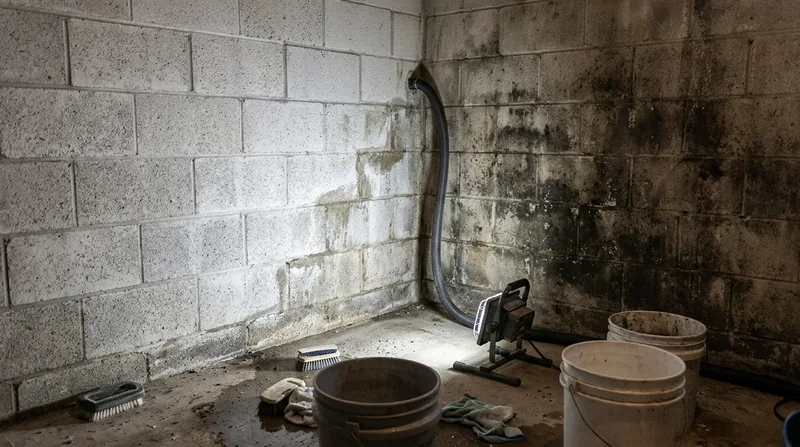




If your Ann Arbor basement smells musty after the spring thaw, or you found dark staining along the base of a block wall in Burns Park, you are looking at Basement Mold Remediation in Ann Arbor done the right way: kill the growth, then fix the water that fed it. This city sits on glacial clay loam over sand and gravel, and the Huron River valley keeps the water table high from late winter into spring. Snowmelt and slow-draining clay push water against footing drains and into low corners, while long freeze-thaw winters open hairline cracks in fieldstone, early poured concrete and block walls. Remediation without a moisture fix is a callback waiting to happen, so we pair containment and treatment with drainage or dehumidification. Start with a free basement inspection and we will tell you plainly what is growing and why.
Why Basement Mold Grows So Fast in Ann Arbor's Older Housing Stock
Most of the basements we open in the Old West Side and Kerrytown were never designed for dry air. Fieldstone and early poured walls weep, the clay outside holds water against the foundation, and a full basement with no vapor barrier keeps relative humidity high all summer. Add a sump pump that quits during a July thunderstorm and you have the two conditions mold needs: moisture and organic material like paper-faced drywall, wood framing and cardboard.
- Fieldstone and early concrete walls in 1900s-1920s bungalows wick groundwater and feed efflorescence and surface growth along the mortar joints.
- Slow-draining glacial clay soil holds snowmelt against the footing drain, so low corners stay damp into May.
- Hairline cracks opened by the freeze-thaw cycle let wall seepage reach drywall and framing after every heavy rain.
- A failed or undersized sump pump leaves standing water that turns into growth within 48 to 72 hours.
Treating the visible growth without addressing any of these is cosmetic work, and it will not hold through the next wet season.
Key info: A 1950s ranch in Westgate that floods every March usually needs an interior perimeter drain and a reliable sump before remediation makes sense. A 1920s foursquare on the Old West Side with a damp but never-flooded fieldstone wall often needs vapor control and targeted crack sealing instead. The diagnosis drives the scope.
For official guidance on moisture and mold in housing, see the EPA's mold resources.
How We Run Basement Mold Remediation in Ann Arbor, Step by Step
We work from the water backward. The first hour is a musty smell diagnostic and moisture survey: pin meter readings on framing and drywall, a look at the sump basin and check valve, and a walk of the exterior grade and downspout extensions. Then we contain, treat and correct, in that order, so the growth does not return to the same wet materials.
- We isolate the work area with plastic sheeting and negative air pressure so spores do not migrate into the living space above.
- We remove porous materials that cannot be cleaned, such as saturated drywall, insulation and cardboard, and bag them on site.
- We HEPA-vacuum and treat affected framing and block surfaces with an approved antimicrobial, then verify with moisture readings before closing anything up.
- We correct the moisture source: crack injection, an interior drain tile system, a sump pump replacement with battery backup, or a vapor barrier and dehumidification strategy.
- We recheck the space after the next rain or snowmelt to confirm the readings hold.
Every job ends with a written moisture record so you know what was wet, what we did, and what to watch.
Key info: In a Pittsfield split-level with a poured full basement, we found growth only on the lower two feet of a north wall. The cause was a clogged footing drain backing up, not a wall failure. Clearing and repairing the drain solved it, and the homeowner avoided a full excavation. See drain tile repair and replacement for that scope.
Remediation and Moisture Approaches We Use in Ann Arbor Basements
The right approach depends on whether the moisture is vapor, seepage or standing water. We match the method to the failure mode instead of selling one system to every house.
| Approach | Description | Best for |
|---|---|---|
| Containment and surface treatment | Sealed work zone, HEPA vacuuming, antimicrobial treatment of framing and block | Localized growth from a one-time leak or humid summer |
| Crack injection plus wall sealing | Epoxy or polyurethane injection of active cracks, then a breathable sealer | Hairline seepage opened by the freeze-thaw cycle |
| Interior perimeter drain and sump | Interior drain tile to a sump basin with a reliable pump and check valve | Hydrostatic pressure and water rising at the wall-floor joint |
| Vapor barrier and dehumidification | Wall and floor vapor control plus sized dehumidification | Chronically damp basements with high summer humidity |
Most Ann Arbor jobs combine two of these, because the water source and the affected materials are rarely the same problem.
Basement Mold Remediation Cost in Ann Arbor: What to Expect
Remediation in this market starts from $1,500 for a contained, single-area job with a clear moisture source. From there the number moves with square footage affected, how much porous material has to come out, and whether drainage work is part of the fix. A damp corner in a Saline ranch and a flooded full basement in a 1960s Pittsfield subdivision are not the same job.
- Access and containment difficulty, including finished ceilings and tight mechanical rooms, drives labor hours.
- The size of the affected area and how deep the growth reaches into framing and drywall.
- Whether the moisture fix is a simple crack injection or a full interior drain tile and sump installation.
- Dehumidification and verification time after treatment, which we do not skip.
Get two or three written estimates and compare scope, not just the bottom line. Our pricing overview breaks down how each component is priced.
Hiring a Basement Mold Remediation Contractor Near Me in Ann Arbor
Ask three questions before anyone starts spraying: what is the moisture source, how will you verify it is fixed, and are you licensed and insured for this work. A contractor who cannot name the water path is guessing. Get at least two estimates, ask for local references from the last year, and confirm the scope in writing.
Permits are commonly required for structural foundation repair and for work that alters drainage or the sanitary connection of a sump discharge, and thresholds vary by jurisdiction. Verify with the City of Ann Arbor building department before work begins. If your home is in a historic district, exterior changes may need review as well.
Call Ann Arbor Waterproofing at (734) 519-7691 to schedule a free inspection and a written estimate.
Basement Mold Remediation in Ann Arbor: Pricing Guide
| Service | Price | Details |
|---|---|---|
| Contained single-area remediation | Starting at $1,500 | Includes containment, HEPA vacuuming, antimicrobial treatment and moisture verification for one affected area |
| Full basement remediation with moisture fix | Starting at $3,200 | Adds removal of porous materials and correction of the water source, such as crack injection or wall sealing |
| Remediation plus drainage correction | On estimate | Interior drain tile, sump pump replacement or vapor barrier scope is priced after an on-site moisture survey |
| Travel | Included | in Ann Arbor and surrounding areas, no separate call-out or mileage fee |
| Estimate | Free | Response within 24h at (734) 519-7691, no obligation to book |
Indicative pricing, the exact cost depends on square footage, finish, and site access. Free personalized estimate within 24h at (734) 519-7691.


